

Selling a probate home in California means the court-appointed executor or administrator lists the property, gets a court-ordered appraisal from a probate referee, and either sells under full court supervision (with a confirmation hearing and possible overbidding in open court) or, more commonly, under the Independent Administration of Estates Act (IAEA), which lets the executor sell without a hearing in most cases. The process typically runs 6 months to 2 years depending on the estate’s complexity and whether anyone contests the will.
Losing a parent or relative is hard enough. Then someone hands you a stack of court papers and tells you that you’re now responsible for selling their house. In Ontario, Fontana, Rancho Cucamonga, San Bernardino, Riverside, and across the Inland Empire, we talk to families going through exactly this every week. Most of them have never touched a probate case before, and honestly, neither have most real estate agents.
That’s the problem. A regular home sale and a probate home sale are not the same transaction. One mistake – filing the wrong petition, skipping a required notice, pricing the home without a certified appraisal – can add months to a process that’s already dragging on your family. This guide breaks down what actually happens, what it costs, and how heirs and executors in Southern California can move through it without losing their minds.
What Makes a Probate Sale Different from a Regular Home Sale
When someone dies owning real estate in their own name (not in a trust), that property usually has to go through probate court before it can legally change hands. A judge appoints an executor (named in the will) or an administrator (if there’s no will) to manage the estate. That person doesn’t own the house. They’re legally responsible for it, which is a different thing entirely.
The executor has to inventory the estate, notify creditors and heirs, get the property appraised by a court-appointed probate referee, and then sell it – often to pay off debts, split proceeds among heirs, or simply because nobody in the family wants to keep it. Buyers know this is a probate sale going in. Some love the potential deal. Others get spooked by the paperwork and walk. You need an agent who’s handled this before, not one learning on your file.
Two Paths Through California Probate Real Estate
California gives executors two routes, and which one applies changes everything about your timeline.
Full authority under the Independent Administration of Estates Act (IAEA). Most wills grant this. It lets the executor list, negotiate, and close a sale without a judge signing off on every step. You still have to send a Notice of Proposed Action to heirs 15 days before closing, but if nobody objects, you’re done. No courtroom, no overbidding strangers.
Limited authority requiring court confirmation. Some estates don’t get full IAEA powers – sometimes the will restricts it, sometimes there’s family conflict. Here, every sale needs a judge’s approval at a confirmation hearing. And at that hearing, anyone in the courtroom can overbid the accepted offer, as long as they beat it by a set legal margin. Yes, this really happens. A buyer thinks they’ve got the house, then someone in the back row bids it up in open court.
If you’re not sure which authority your estate has, check the Letters of Administration or Letters Testamentary the court issued. It’s usually right there on the document. Our team at The Acevedo Team walks Inland Empire families through this distinction constantly – it’s the single biggest factor in how fast your sale can move.
Where This Plays Out Across the Inland Empire and Southern California
Probate filings run through the county where the deceased lived, so your case might sit in San Bernardino County Superior Court or Riverside County Superior Court depending on the address. We work probate estates across Ontario, Fontana, Rancho Cucamonga, Rialto, Bloomington, Jurupa Valley, Pomona, Montclair, Diamond Bar, Corona, Perris, Moreno Valley, Menifee, Temecula, Murrieta, and Hemet.
Local matters here more than people expect. A San Bernardino County probate referee values a Fontana ranch house differently than a Riverside County referee would price a Temecula property near wine country. Local comps, local contractor networks for pre-sale repairs, local title companies who already know how probate escrow works – all of it speeds things up. An out-of-area agent unfamiliar with Inland Empire real estate will spend weeks catching up on things a local team already knows cold.
What a Probate Home Sale Actually Costs
Executors get reimbursed for reasonable estate expenses, but you’re still working with the estate’s money, not your own, so every dollar matters. Expect these line items:
| Cost Category | Typical Range |
| Probate referee appraisal fee | Set by statute, roughly 0.1% of appraised value |
| Court filing fees | $435-$1,200+ depending on county and petitions filed |
| Real estate agent commission | Standard market rate, negotiable |
| Pre-sale repairs/cleanout | Varies widely – often the biggest surprise cost |
| Attorney fees (if using probate counsel) | Statutory fee based on estate value, or hourly |
One thing families underestimate constantly: deferred maintenance. Inherited homes often sat empty or were lived in by an aging owner who couldn’t keep up repairs. A leaking roof or an old HVAC system can tank your appraisal or scare off buyers who don’t want a fixer-upper mid-probate.
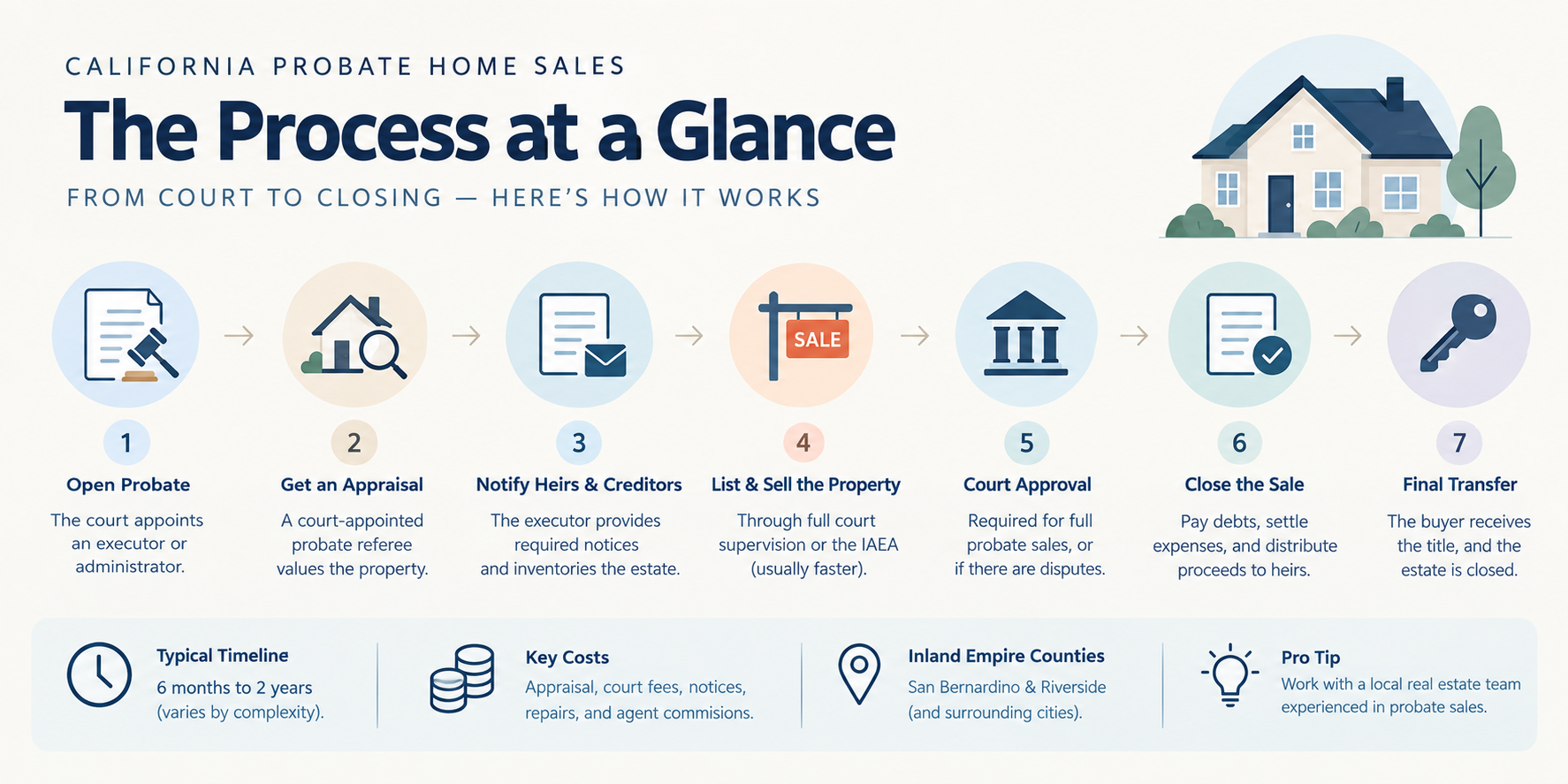
The Actual Steps, In Order
- Petition the court to open probate and get appointed executor or administrator.
- Receive Letters Testamentary or Letters of Administration – this is your legal authority to act.
- Get the property appraised by the court-assigned probate referee.
- List the home with an agent experienced in probate real estate transactions.
- Accept an offer, then either send the 15-day Notice of Proposed Action (IAEA) or schedule a confirmation hearing (court supervision).
- Close escrow and distribute proceeds per the will or intestate succession law.
We’ll be publishing a full breakdown on how long probate takes in California when real estate is involved as a standalone guide soon – the short version is that timelines swing wildly based on whether the estate is contested, whether there’s IAEA authority, and how many heirs need to sign off.
Can You List or Sell Before Probate Closes?
Short answer: yes, in many cases, and this trips people up constantly. Executors with IAEA authority can list and even accept an offer before the entire probate case wraps up – the sale itself just needs the proper notice period or confirmation. We’re putting together a dedicated guide on selling a house before probate is complete in California, because the rules around timing catch even seasoned families off guard, especially when there’s a mortgage payment still due on a vacant house every month probate drags on.
Working With a Probate Real Estate Specialist
This is where most families get stuck. A general listing agent might know how to stage a house and run comps. That’s not the same skill set as understanding probate services, overbid procedures, referee coordination, and heir communication when three siblings disagree about the asking price.
Look for an agent who’s actually sat through a confirmation hearing. Ask how many probate transactions they closed in the last year. Ask if they coordinate directly with probate attorneys and title companies who specialize in these files – because a title company unfamiliar with probate documentation will hold up your closing for weeks over paperwork a specialist would clear in days.
If the property needs repairs before listing and the estate has no cash to fund them, ask about pre-sale funding options too. Some teams front repair costs and recoup them at closing, which matters a lot when an estate account has $4,000 in it and the roof needs $18,000 of work.
What Heirs Should Know Even If They’re Not the Executor
If you’re an heir but not the executor, you still have rights. You’re entitled to notice of major actions, including the proposed sale price under IAEA. If you think the home is being sold below market value, you can object within the notice period – that’s exactly what it’s there for. Silence during that 15-day window, though, is treated as consent. Don’t sit on the notice if you have concerns.
Family conflict during probate is common, and it’s usually not really about the house. Money after a death tends to surface old tension. A good probate agent stays neutral, communicates with every heir the same way, and documents everything in writing so nobody can claim later they weren’t told.
Get Local Help Before You File Anything
Every county handles probate paperwork a little differently, and every local market has its own quirks. If you’re managing an inherited property anywhere from Ontario to Temecula, reach out to our team before you list. A short call upfront can save you months down the road – we’ve seen it happen more times than we can count.
Frequently Asked Questions
Do I need a lawyer to sell a house in probate in California?
Not always. If the executor has full IAEA authority, many sales close without an attorney actively managing the transaction, though most families still use one for the initial petition. If the estate requires court confirmation, having probate counsel is strongly recommended since the hearing process involves legal notices and overbid procedures.
Can a house be sold during probate without going to court?
Yes, if the executor has Independent Administration authority. The sale still requires a 15-day Notice of Proposed Action to heirs, but it skips the courtroom confirmation hearing entirely as long as nobody objects.
How is the sale price of a probate home determined in California?
A court-appointed probate referee sets an official appraised value, called the Probate Referee’s Appraisal. Under IAEA, the home generally can’t sell for less than 90% of that appraised value without additional steps.
What happens if multiple heirs disagree about selling the house?
The executor still holds legal authority to sell, but disagreeing heirs can file objections during the notice period or petition the court directly. Mediation between heirs often resolves this faster and cheaper than a contested hearing.